
How SEO and Content Marketing Work Together to Increase Online Visibility
The release of necessary articles alone cannot be sufficient for locating niche readers. Even if a site has been technically optimized, the presence of low-quality and unrelated text will render its optimization useless. Content Marketing and SEO must work together, meaning that search information will determine readers’ requirements, and the relevant content will correspond to these requirements and lead the customers to further actions.
This integration gives each page a clear function. The service pages solve commercial searches; guides solve research needs; case studies provide proof.

How Content Marketing Affects SEO Strategy
SEO Strategy for service businesses provides information about demand, intent, competition and performance. The editorial technique transforms this information into information that can be read by human beings.
A connected approach combines:
- Keyword research based on relevant customer needs
- Clear page purposes and search-intent mapping
- Useful content written with subject knowledge
- Technical access and on-page optimisation
- Internal linking between related resources
- Regular content updates based on performance
- Measurement tied to enquiries, sales or other goals
The aim is to build a useful content library around topics connected to the business and its audience, not every available keyword.
SEO and Editorial Roles Compared
Area | SEO contribution | Editorial contribution | Combined result |
Audience research | Identifies queries, demand and result types | Adds customer language and real questions | Topics reflect actual needs |
Page planning | Maps keywords and intent to URLs | Defines format, angle and depth | Each page has a clear purpose |
Content creation | Guides headings, relevance and metadata | Provides evidence, examples and readable explanations | Pages serve readers and search context |
Internal links | Identifies priority and orphan pages | Adds natural contextual connections | Related resources form a usable journey |
Optimisation | Reviews visibility and technical signals | Refreshes accuracy and usefulness | Existing pages improve over time |
Measurement | Tracks search and conversion data | Interprets engagement and content gaps | Future work follows evidence |
A page that is technically optimized should, however, be substantial, while a solid piece of writing needs to have a well-defined website role.
Establish the Strategy Based on the Intent of Search
Keyword volume doesn’t account for all the motivation behind a search. Types of results and the customer journey can determine if the user is looking for educational, comparative, product or service information.
Group relevant terms by intent before assigning pages. This reduces competing articles and helps determine the right format.
Common intent groups include:
- Informational refers to the necessity of explanation or instruction for the reader.
- Comparative means that the reader is involved in assessment of a technique, product, or service.
- Commercial indicates that the reader is currently evaluating a solution or service.
- This implies that the reader is going to move to the stage of inquiries, bookings, or purchases.
Navigational implies that the reader needs a particular brand or website.
Give Every Topic the Right Page
Creating an article for every phrase produces overlap and thin pages. Map each topic to the page type most capable of satisfying it.
For example:
- A service query usually belongs on a complete service page.
- A definition or step-by-step query may suit an educational guide.
- Product comparisons may need a buying guide or category resource.
- Location-focused needs may require a genuine location page.
- Evidence-led searches can be supported through case studies or original research.
Review existing pages first. An established URL may need expansion or restructuring rather than another competing article.
Create Useful Content Before Optimising It
A brief should define the reader, purpose, evidence requirements and intended next step. Keywords guide the scope without dictating every sentence.
Strong pages normally include:
- A direct opening that establishes the subject
- Logical H2 and H3 sections
- Relevant steps, examples or comparisons
- Accurate facts supported by suitable sources
- Clear explanations of limitations or requirements
- Original business knowledge where it adds value
- A suitable subsequent action instead of a multitude of conflicting suggestions
ISO 24495-1 stands for international standards governing plain language, which aid in the easy reading of written works.
Technical data may include lots of details, yet the form of the information can be made simpler and easier for the specific audience.
Apply On-Page Optimisation With Restraint
Once the page answers its main need, review its title, H1, subheadings, URL, metadata, images and internal links together.
Keep these principles in mind:
- Use one clear primary topic for each indexable page.
- Add related phrases only where they improve meaning.
- Make the title and opening consistent with the page content.
- Use headings to divide the answer, not to repeat keywords.
- Write image alt text for relevant content or function.
- Keep the URL short, readable and stable.
An on-page SEO checklist can provide a repeatable review process for priority pages.
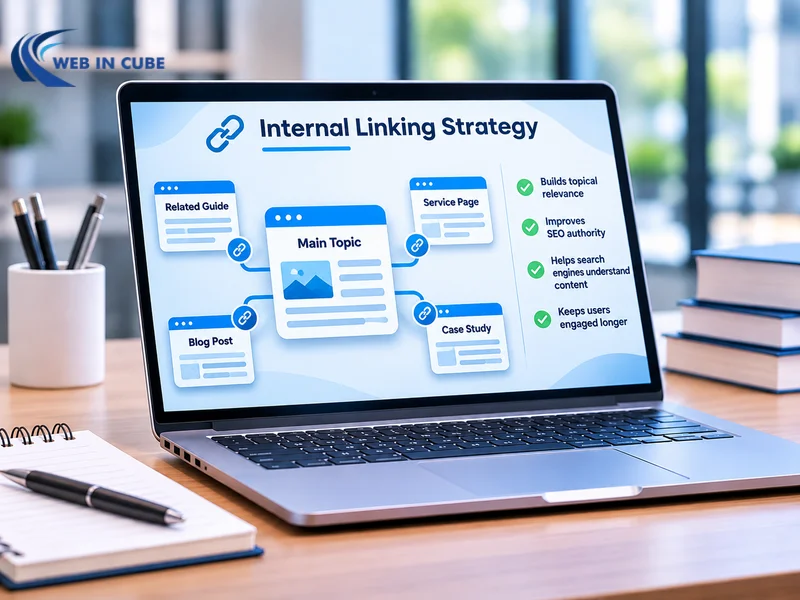
Use Internal Links to Build a Connected Content Library
Internal links move readers from an initial question to a guide, service, case study or enquiry page. They also prevent valuable resources from becoming isolated.
Add links where the destination continues the subject. Use descriptive link text that communicates the destination rather than wording such as “click here.” W3C documents this as a technique supporting clear link purpose.
A practical cluster may contain:
- One main service or topic page
- Supporting guides addressing related questions
- Case studies or examples demonstrating outcomes
- Comparison pages for important decisions
- Relevant links back to the main page and between supporting resources
A small number of useful connections keeps the reading path clear.
Strengthen Existing Pages Before Publishing More
Many websites contain pages with impressions, backlinks or useful history. Content optimisation can improve those assets without starting from zero.
Review existing pages for:
- Outdated facts, screenshots or examples
- Sections that no longer match search intent
- Questions that remain unanswered
- Weak titles or introductions
- Overlap with another page
- Missing links to relevant services or guides
- Traffic without enquiries or engagement
The correct action may be to update, combine or retire the page. Record major edits and compare equivalent periods afterwards.
Support Distribution and Authority
The effective resource may be helpful in generating content for newsletters, social media posts, sales talks, outreach, and digital PR. The distribution process could end up with citations or even brand mentions.
Repurposing needs to fit the concept for each particular channel. A guide might become an email series, visual checklist or several focused social posts.
The WebinCube content services overview connects planning, creation and distribution.
Measure Visibility and Business Value Together
Organic visibility alone does not show whether content supports the business. Combine search metrics with reader behaviour and outcomes.
Useful measures include:
- Impressions and clicks for relevant queries
- Performance of priority landing pages
- Growth across a related topic group
- Internal-link visits to service or product pages
- Enquiries, bookings, purchases or assisted conversions
- Backlinks and credible brand mentions
- Engagement with updated resources
Review patterns rather than one ranking. A page may attract qualified traffic without high volume, while a broad article may generate visits that never progress.
Common Mistakes Restricting Effectiveness
There can be no synergy between SEO and editorial activities.
Avoid:
- Producing articles only to meet a monthly quota
- Targeting several unrelated intents on one page
- Creating multiple pages for minor keyword variations
- Adding keywords after writing without improving the answer
- Publishing content without internal links or a defined role
- Leaving successful pages outdated
- Traffic reporting without conversion data or any page context
The process of reporting on the above-mentioned points needs to be clearly defined with roles assigned to each task.

Conclusion
The skill of SEO content marketing integration will ensure that you turn your audience research into tangible, quantifiable data about your website. You can find opportunities by looking for search evidence that is then applied through effective content, on-page optimization, use of links, as well as continuous improvement processes.
At WebinCube, we bring together content and SEO with web design & development, ecommerce, PPC and social media. Therefore, all channels follow the same customer journey path. An important thing to do at this point is to look into the five most important topics on the website, make sure you have the correct pages for those topics, and pick one gap to focus on.
Frequently Asked Questions
1. Does every business need to publish weekly?
No. Publishing frequency should reflect available expertise, meaningful topic gaps and the ability to maintain quality. One complete resource can provide more value than several thin articles.
2. Should keywords be added before or after writing?
Research should guide the topic and structure before drafting. Final optimisation can refine headings, wording and metadata after the page provides a complete answer.
3. Can old content continue to support visibility?
Yes. Accurate and useful evergreen pages can perform for years, but they still need periodic reviews for outdated information, broken links, changed intent and new customer questions.
4. How many internal links should an article contain?
There is no fixed number. Add links that help the reader continue the topic or reach a relevant service. Avoid unrelated destinations and repeated anchors added solely for volume.
5. Which results should be reviewed first?
Start with qualified enquiries, sales or other business outcomes, then use landing-page traffic, queries and engagement to explain what contributed to those results.