
White Hat vs. Black Hat Link Building: Which Is Better?
Backlinks may improve a site’s authority, but the means by which these backlinks are acquired is just as important as the quantity that is achieved. In ethical link building, publishers are presented with a legitimate reason to cite useful content. Unethical link building tries to establish authority artificially, either by paying or automating the process, by being deceptive, or by using websites established for placing links.
Although the two placements may look the same in all respects, they may differ in terms of their editorial values and business risks.

What is White Hat Link Building and What Is Black Hat Link Building?
The concept of White Hat techniques relies on creating quality content and establishing good connections with reputable contacts in public relations.
What White Hat Methods Look Like
Ethical acquisition should begin with a focus on the benefits to the audience as well as the publisher. The page of origin should offer value in terms of evidence, knowledge, facts or advice.
Common methods include:
- Digital PR based on genuine news, research or expert commentary
- Original studies, tools, templates and useful industry resources
- Relevant guest contributions with clear editorial oversight
- Reclaiming legitimate lost links or unlinked brand mentions
- Replacing a broken resource with a suitable current page
Connections with people, cooperation and interacting with the community
It requires research and communication efforts, but there is an underlying reason behind each of these approaches, not limited to visibility control.
The Basics of Black Hat Strategies
Controlling acquisition means simply being effective, efficient, and in command regardless of the audience, publisher or where the article is being published.
Warning signs include:
- Private networks built mainly to sell or exchange backlinks
- Bulk purchases across unrelated websites
- Automated blog comments, forum profiles or directory submissions
- Hidden links or links placed on compromised websites
- Repeated exact-match anchor text across many domains
- Reciprocal Link Campaigns Without Any True Partnership
- Rehashed Content on Insignificant Websites
Not all directories, mentions, or reciprocal links are necessarily bad. The problem occurs when the exchange becomes solely about sending out ranking signals.
The Difference Between White Hat and Black Hat Techniques
Evaluation area | White hat approach | Black hat approach |
Primary purpose | Help an audience and earn a relevant reference | Influence rankings through artificial signals |
Publisher selection | Based on topic, audience and credibility | Based mainly on availability or volume |
Content quality | Original, useful and editorially reviewed | Thin, duplicated or created only for placement |
Anchor text | Natural wording suited to the sentence | Repetitive commercial keywords controlled at scale |
Transparency | Relationships and sponsorships are disclosed | Payments or ownership may be concealed |
Reporting | Shows context, destination and relevance | Focuses on totals and third-party scores |
Long-term value | Can support referral traffic, reputation and authority | May disappear quickly or create avoidable risk |
Consider each possibility separately. A seemingly respectable website may have substandard sponsored pages, while a smaller specialized magazine could have a relevant editorial reference.
Why Cheap Backlink Packages Create Business Risk
Bulk packages appear easy to measure. A report indicating 100 new backlinks will appear credible, regardless of whether the links hold no real substance.
Here is an example of a few difficulties that poor-quality campaigns may create:
- Brand mentions appear beside unrelated or unsuitable content
- Links disappear after the reporting period
- Destination pages receive irrelevant visitors
- Anchor text patterns look unnatural
- Teams spend time reviewing or removing placements
- Marketing reports overstate progress without showing business outcomes
A poor placement may also impact how the customers, media and business partners view the brand. The quality of control should be done on both sides of SEO and reputation management.
How Should a Business Review a Backlink Placement?
Search for Popular Topics and Audience
The first thing to think about is the topic of the site and the audience. The backlink should relevantly match the article and lead the audience to usable content.
No single authority metric proves quality. Review recent articles, authorship, editorial consistency, audience signals and referenced websites.
Editorial Rationale Review
Consider the reasons that the publisher may have for mentioning the page. Examples include original research, a useful tool, expertise in the topic, explanations or a business connection.
SEO cannot be used as the sole reason, because the link does not make any sense once the SEO is removed from the picture.
Review the Destination Page
Even good outreach can’t save an otherwise weak destination page. The page must be accurate, up-to-date and well-aligned with the context.
Before you reach out, improve the page by:
- Clear evidence or first-hand expertise
- Useful examples, visuals or downloadable resources
- Transparent authorship and relevant credentials
- Supporting internal links
- A logical next step for interested visitors
A broader content marketing approach may assist in finding valuable content that needs promotion instead of just making an article for getting backlinks.
Anchor Text Must Be Natural
The anchor text must describe the destination and not fit into a commercial phrase in a sentence. Branding, page title, and natural description suit editorial content more than keyword matching.
Naturally written publishers maintain editorial independence. Tightly controlled anchors across unrelated domains deserve review.
Confirm Commercial Transparency
Paid contributions, sponsorships, and other business associations need to be explicitly addressed. According to the OECD, endorsements must be factual, and material associations need to be openly stated.
The relationship can also be stated through technical link attributes. As per the WHATWG HTML standard, the nofollow link tag can be used to indicate a link that is not supported or for commercial reasons.
Disclosure and linking tags are ways of ensuring correct execution, even though they cannot replace relevance and quality of content.
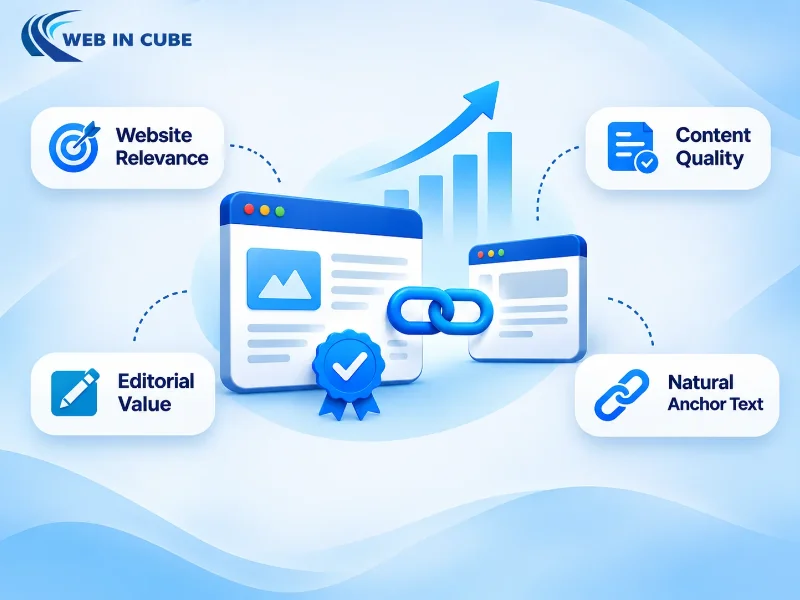
A Sustainable Link Acquisition Process
1. Review the Existing Backlink Profile
Record referring domains, destination pages, anchor patterns and suspicious clusters. Separate valid concerns from irrelevant mentions before taking any action.
An extended SEO audit checklist could help link results be correlated with technical, content and conversion factors.
2. Finding Relevant Web Pages
Identify the service, research, guide or tool webpages that should get more emphasis rather than getting opportunities just for the homepage.
3. Generate a List of Prospects
Look for industry blogs, relevant organizations, journalists, and legitimate partners. Screen each contact before contacting them.
4. Make the Outreach Stand Out by Making a Compelling Case
Elaborate on the rationale behind your choice and show how the information you offer relates to the publication. Do not use any general letter template while pitching.
5. Validate and Track the Placements
Verify the referrer, context, destination, anchor, and linking attributes. Monitor new and lost references and record referral visits where available.

What Should a Link Report Include?
A useful report should include:
- Referring page and domain
- Date found or published
- Destination URL
- Anchor text and surrounding context
- Link attribute
- Acquisition method
- Relevance and quality notes
- Current live status
Domain-level metrics are not the final result. Reports should explain which pages received support, which outreach angles worked and where adjustments are needed.
How Should Results Be Measured?
Backlinks are an input, not the complete outcome. Review:
- Growth in relevant referring domains
- Referral visits from earned placements
- Visibility of supported pages
- Brand mentions and editorial coverage
- Enquiries or assisted conversions
- Lost-link recovery
- Quality and diversity of anchor text
Short-term ranking movement has several possible causes. Look for consistent progress across relevant pages and longer reporting periods.
Conclusion
Good Link Building should build authority while avoiding damaging the editorial integrity and brand image. Since white-hat link building requires planning based on appropriate content, right publications and the right reason to link to a web page, this could yield links with more value than just for the ranking sheet.
Link building is integrated at WebinCube with SEO, content creation, web design and development, e-commerce, paid search and social media so that everything done off-page is linked to the customer experience as a whole. A logical next move would be to evaluate the relevance and transparency of recent backlinks and discontinue poor practices in the future campaign strategy.
FAQs
1. Is every paid backlink a black hat tactic?
No. Sponsorships and advertising can be legitimate when the relationship is transparent and implemented appropriately. Risk increases when payment is concealed and the placement exists mainly to manipulate rankings.
2. Are directory links still useful?
Relevant professional, industry, and local directories can help customers verify or find a business. Mass submissions to unrelated directories offer little audience value and can create a poor-quality backlink pattern.
3. How many backlinks should a business earn each month?
There is no universal target. Industry competition, available assets, publisher response rates and quality standards affect the pace. A small number of credible references can be more meaningful than a large package of weak placements.
4. Should suspicious backlinks always be removed?
Not automatically. Review their source, pattern and potential impact before taking action. Random low-quality links can appear without the business creating them, so decisions should be based on evidence rather than fear.
5. How long does ethical acquisition take?
Research, content development, outreach and editorial review take time. Results depend on the strength of the resource and relevance of the proposal, making steady quality control more useful than fixed placement promises.