AI SEO services vs Traditional SEO: What’s the Difference for Businesses?
Search no longer presents information in one format. A customer may click a webpage, read a map listing or receive an AI summary. AI SEO helps facilitate the whole process by enhancing the visibility and interpretation of the company in generated responses.
Traditional optimization has not been made redundant. Search engines and AI engines still require visible web pages, authentic content and tangible evidence. The difference is in terms of the visibility to be gained, the influencers of visibility and its measurement.
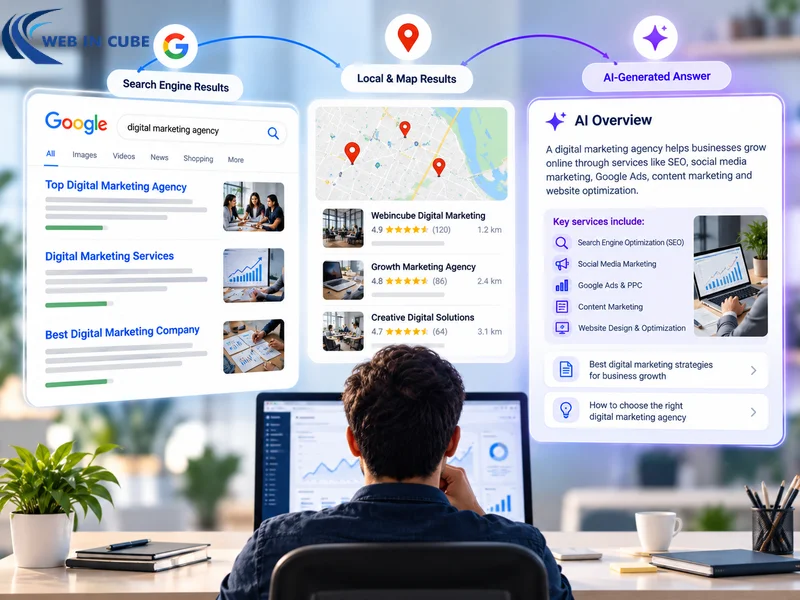
What Are the Differences Between AI SEO Services and Normal SEO?
The process of SEO in general consists of the development of good positions through search engine optimization of crawlability, relevance, authority, and user experience.
In AI-oriented optimization, consideration is given to whether generative models would be able to find the company, get an answer and cite it.
Area | Traditional SEO | AI-focused optimisation |
Main visibility | Ranked links, local results and product results | Citations, mentions and inclusion in AI-generated answers |
Query focus | Keywords and established search intent | Natural-language questions, comparisons and follow-up queries |
Content priority | Relevant pages that satisfy a search result | Clear, evidence-led passages that can support a generated response |
Authority signals | Backlinks, topical coverage and recognised expertise | Consistent entities, third-party corroboration and source quality |
Technical work | Crawling, indexing, speed, architecture and mobile usability | The same foundations plus machine-readable context and clear relationships |
Measurement | Rankings, impressions, clicks, leads and revenue | Citations, answer accuracy, AI referrals, assisted conversions and brand presence |
Some features common to both are listed below. A site that is difficult to access, slow, or disorganized would be challenging for both techniques. In the search engine technique, the ranking of the site is performed, whereas in the generative technique, snippets from the website are used along with other resources.
Which SEO Foundations Still Matter?
AI search has not removed technical and editorial discipline. Pages must remain crawlable, logically connected and clear about their purpose. Foundations include:
- Crawlable pages with correct indexation and canonical signals
- Descriptive titles, headings and internal links
- Fast, mobile-friendly templates
- Original information that answers a defined need
- Accurate authorship, dates and supporting sources
- Relevant backlinks and genuine industry mentions
- Structured information that corresponds with the content displayed on the page
These components assist in ranking the site as well as making it easier for people to use the information. The manual of technical SEO issues by WebinCube covers crawling, performance, duplication, and architecture of a site.
AI visibility is more stable if the website is able to express the subject, ownership, and credibility clearly.
Where Does AI Search Change the Work?
The newer work centres on how information is expressed, supported and connected across the web.
Conversational questions become more important
Traditional keyword research might identify “commercial solar maintenance.” An AI-focused review also examines related questions:
- What kind of maintenance does a commercial solar energy system need?
- When do warning signs need the intervention of a technician?
- How frequent is performance evaluation?
- What impacts the cost of maintenance?
- Who is responsible for which aspect?
Do not turn each question into a thin page. Group related needs, answer them directly and provide an appropriate next step.
Entity clarity matters across the website
An entity can refer to either one person, business, commodity, location or an idea. In order to bring consistency to the name, function, place of operation, and qualifications of a company, its communication efforts must be improved.
Entity optimization solves the problem of inconsistencies between various pieces of information related to the entities. It also ties authors to relevant areas of expertise and explains the relationships between services, thus making the whole process less ambiguous.
Content needs extractable evidence
Length alone does not make content useful. Important points should be easy to locate, interpret and support through:
- Short definitions followed by necessary detail
- Direct answers to specific questions
- Tables that compare defined options
- Numbered processes with clear requirements
- Original statistics, examples or observations
- Citations placed beside the claims they support
The initial research on Generative Engine Optimisation demonstrated that optimization outcomes differed by discipline. There is no one-size-fits-all strategy for formatting.

Is the usability of SEO techniques affecting business?
Traditional search comes into play when customers have to select one vendor among many, seek service pages, find a store, or make a purchase. An artificial intelligence reference might be used to introduce the brand, but the website has to back up the next step.
Commercial pages therefore require:
- Clear service or product information
- Relevant locations and availability
- Evidence such as case studies, credentials and reviews
- Useful comparisons without unsupported claims
- Simple enquiry, booking or purchasing paths
- Accurate conversion tracking
Local businesses need consistent location signals and useful local pages. Stores need indexable categories, complete product information and reliable checkout. Answer-engine tactics do not replace these responsibilities.
WebinCube’s SEO services overview explains how technical health, content, authority and emerging AI visibility work as connected parts of search strategy.
How Should AI Search Visibility Be Measured?
Rank tracking alone cannot show whether a brand appears inside generated responses. Measurement needs a wider set of indicators:
- Citations linking to the business website
- Brand mentions with and without a link
- Accuracy of descriptions, services and locations
- Pages most often referenced by AI systems
- Referral sessions from identifiable AI platforms
- Enquiries or sales assisted by those visits
- Changes across different prompts and engines
The Microsoft AI Performance report highlights the references made by publishers to Copilot, Bing summaries created using AI, and certain integrations. The references include cited URLs and trends.
The entity may be one of the following: person, company, product, place or idea. An organization becomes helpful where there is consistency in name, services, location and credentials of the organization.
Improvements to the entity will be used in order to remove contradictions, link the author with his/her knowledge and disassociate services from each other.
What Should a Business Prioritise First?
A sensible sequence protects current search performance while adding work for generative visibility.
1. Establish the existing baseline
Record organic visibility, priority pages, leads and technical issues. Note which content already supports customer decisions.
2. Map important customer questions
Collect questions from sales calls, support emails and search data. Group them by research stage, commercial value and existing coverage.
3. Enhance the best pages that already exist
Enhance facts, headings, evidence, internal links, and follow-up actions prior to developing new pages. WebinCube’s content marketing tips tie audience research to business objectives.
4. Check brand information beyond the website
Review relevant directories, professional profiles and industry publications. Correct inconsistencies and pursue legitimate coverage supported by real expertise.
5. Add AI reporting to existing SEO measurement
Monitor citations and brand representation alongside rankings, traffic and conversions. Visibility should support informed customer action.
Common Mistakes to Avoid
The expansion of AI search has also created weak shortcuts. Businesses should avoid:
- Publishing large volumes of lightly reviewed AI-generated content
- Adding unsupported statistics or invented sources
- Creating near-identical pages for every conversational question
- Treating one chatbot response as proof of sustained visibility
- Abandoning technical SEO, internal linking or conversion work
- Promising guaranteed inclusion in generated answers
- Reporting mentions without checking accuracy or business impact
Human review remains essential. Names, prices, regulations, advice and dates require verification. Content should help readers even when no AI system cites it.

Conclusion
AI SEO service needs to be considered as an add-on to your overall SEO strategy, not a replacement for all the work that was done in order to make your website visible, reliable, and valuable. In this case, the focus is made on conversational questions, entity identification, extraction of evidence, third-party validation, and measurement within the experiences created.
At WebinCube, businesses can incorporate this approach with technical SEO, content creation, website building, eCommerce, local visibility, and many more services offered under the digital marketing umbrella. The first step to take after this is to define the questions posed by customers and then analyze whether these questions are answered on any pages of the website or not.
FAQs
1. Is AI-focused SEO replacing traditional SEO?
No. It extends established optimisation into generated answers. Technical health, useful content and authority remain important to both.
2. What is Generative Engine Optimisation?
It is the practice of improving how content and brands appear in responses produced by generative search and answer systems. Work may involve content structure, entities, evidence and external corroboration.
3. Can businesses guarantee citations in AI answers?
No. Generative systems change, prompts vary and source selection remains outside the business’s control. Providers can improve readiness and measure visibility, but guarantees are not credible.
4. Will structured data ensure AI visibility?
No. Structured data will provide clarity to the page information; however, it needs to align with visible content, along with good technical, editorial and authority signals.
5. What kind of results should a business track?
One should track traditional rankings, clicks, leads, revenue, as well as AI citations, brand mentions, answer accuracy, referrals and conversions.